Water Heaters
Gas vs Electric Water Heaters: Which Is Better for Nebraska Winters?
The gas vs electric water heater decision looks straightforward until you factor in a real Nebraska winter — incoming water that’s colder than most of the country deals with, occasional winter power outages, and two very different local utilities setting the actual cost of running either one. Here’s how they actually compare for a Lincoln home, not just in general.
Lincoln’s two utilities: LES and Black Hills Energy
Unlike some cities where one company handles both gas and electric, Lincoln splits the two: Lincoln Electric System (LES) is the city’s publicly owned electric utility, and Black Hills Energy provides natural gas service. Both set their own rates independently, and both can change over time — which is exactly why a “gas is always cheaper” or “electric is always cheaper” answer from a national article doesn’t necessarily hold locally. Checking current rates from both before deciding is worth the ten minutes it takes. Current residential rates from both providers are public — you can check LES’s residential rate schedule and Black Hills Energy’s Nebraska rate information directly, rather than relying on national averages that don’t reflect what you’d actually pay locally.
Upfront and installation cost
Electric water heaters are almost always less expensive to purchase and install than a comparable gas unit, mainly because installation doesn’t require gas line work or venting. If your home doesn’t already have a gas line running to the water heater location, adding one for a new gas unit adds meaningfully to the upfront cost — sometimes enough to offset years of operating savings.
If your home already has gas plumbed to the water heater location, switching within the same fuel type (gas-to-gas or electric-to-electric) during replacement is always simpler and cheaper than switching fuel types.
Operating cost over time
As a general rule, natural gas tends to cost less per unit of heat delivered than electricity, which is why gas water heaters often have a lower long-term operating cost. But the actual gap depends entirely on current LES electric rates versus current Black Hills Energy gas rates, both of which shift over time with broader energy markets. A unit’s efficiency rating matters here too — a well-maintained, properly sized water heater of either fuel type will cost less to run than a neglected or oversized one, regardless of which fuel it uses.
|
Factor |
Gas |
Electric |
|---|---|---|
|
Upfront/installation cost |
Higher, especially if no existing gas line |
Lower, simpler installation |
|
Typical operating cost |
Often lower per gallon heated |
Often higher per gallon heated |
|
Recovery rate (reheating speed) |
Generally faster |
Generally slower |
|
Works during a power outage |
Yes, if it has a standing pilot |
No |
|
Venting required |
Yes |
No |
|
Typical lifespan |
8–12 years |
8–12 years, sometimes slightly longer |
Performance in a Nebraska winter
Incoming groundwater temperature drops noticeably in winter, meaning any water heater has to work harder to reach the same output temperature than it does in summer. This is where recovery rate — how quickly a tank reheats after being drained — becomes genuinely relevant, not just a spec sheet number. Gas units generally recover faster than electric units of a similar size, which matters more in winter when incoming water starts colder and household hot water demand (showers, dishes, laundry) often increases.
Cost is often the deciding factor — see our full water heater repair cost guide for Lincoln, NE homeowners weighing repair versus replacement.
Recovery Rate
The spec that matters most in winter — a faster-recovering gas unit is less likely to run out of hot water back-to-back during cold-weather peak usage than a comparable electric unit.
What happens during a power outage
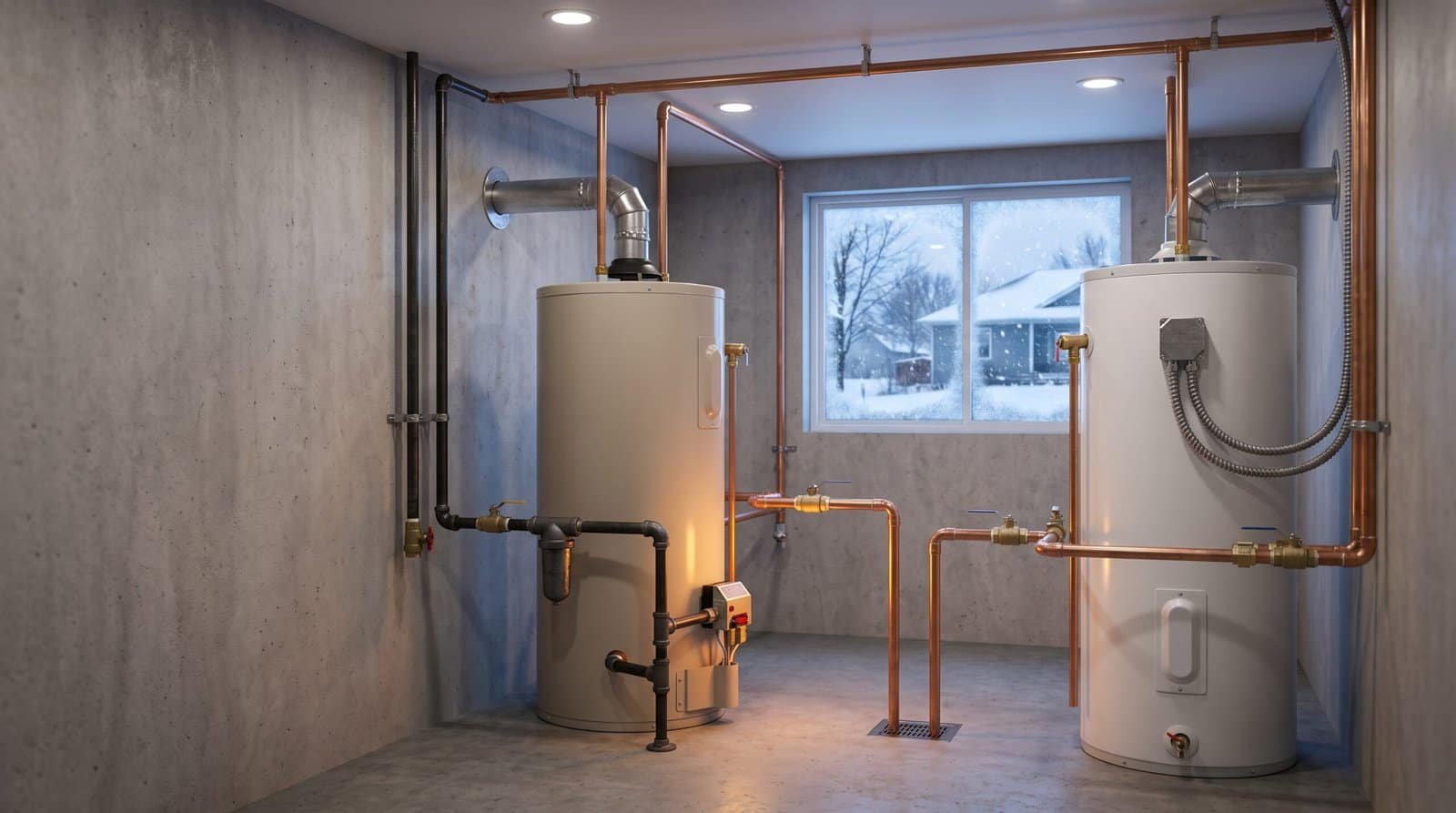
This is the factor most comparison articles skip, and it’s genuinely relevant in Nebraska, where winter storms occasionally knock out power for hours. A gas water heater with a standing pilot light will keep heating water even with the power out, since it doesn’t rely on electricity to ignite. Newer gas units with electronic ignition may not have this advantage. An electric water heater, regardless of type, will not produce hot water at all without power.
If reliable hot water during a winter power outage matters to your household, that’s a real, practical point in favor of a standing-pilot gas unit — not just a marketing angle.
Lifespan and maintenance
Both fuel types have a similar expected lifespan — typically 8 to 12 years, with the same factors (sediment buildup, anode rod condition, water hardness) affecting both roughly equally, since Lincoln’s moderately hard municipal water affects any tank regardless of fuel source. Gas units have a few additional components — the thermocouple, burner assembly, and venting — that can fail independently of the tank itself, while electric units have fewer moving parts but rely on heating elements that can burn out over time.
Gas vs electric water heater: Which one makes sense for you
Gas is usually the better fit if:
- Your home already has a gas line to the water heater location
- Your household uses a lot of hot water back-to-back (large family, multiple showers in a row)
- Reliable hot water during a power outage matters to you
Electric is usually the better fit if:
- Your home doesn’t currently have gas service, and running a new line isn’t worth the cost
- You want the lowest possible upfront/installation cost
- You prefer to avoid combustion appliances and venting requirements entirely
Neither option is objectively better across the board. Whichever you choose, our licensed Plumbers in Lincoln NE can help you install it safely and to code.
Frequently asked questions
Related reading
Related reading
Written by the Next Plumbers Team
Licensed, insured plumbers serving Lincoln, NE and surrounding neighborhoods. We install and repair both gas and electric water heaters — and we’ll tell you honestly which one fits your home, not just which one we’d rather sell.
Not sure which fuel type is right for your home?
We’ll look at your existing setup — gas line, electrical capacity, household usage — and give you a straight recommendation, not a sales pitch.