Water Heater Repair · Lincoln, NE
Water Heater Repair Cost in Lincoln, NE: Repair or Replace?
A real cost breakdown for Lincoln homeowners — what repairs and replacements actually run, what drives the price, and how to know which option makes sense for your unit.
24/7
Emergency Service
100%
Licensed & Insured
Same-Day
Estimates Available
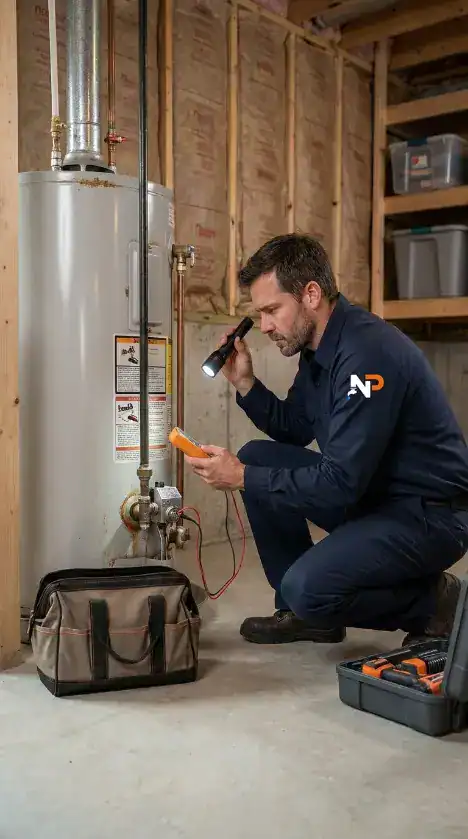
Nationally, most water heater repairs cost between roughly $150 and $700, with smaller fixes like a thermostat or heating element on the lower end and more involved work like a gas control valve or leak repair pushing toward the higher end. Full replacement typically runs $850 to $2,000 installed for a standard tank system, and considerably more for tankless. Where your specific job lands inside those ranges depends on the failure, the equipment, and what your installation requires — which is exactly what an in-person inspection is for.
This guide breaks down realistic repair and replacement costs, what drives them up or down, and how to think through the repair-or-replace decision like a Lincoln homeowner — not a national average.
At a Glance
| Typical repair cost $150–$700 for most jobs (minor fixes as low as $90–$150; major repairs can reach $900+) | Typical replacement cost $850–$2,000 installed for a standard tank; $2,000–$4,500+ for tankless |
| Repair usually makes sense when The unit is young, the tank isn’t leaking or corroded, and the problem is one isolated part | Replacement usually makes sense when The tank is leaking, the unit is old, failures keep repeating, or repair cost nears replacement cost |
Biggest price factors
Type of failure, gas vs. electric, tank vs. tankless, accessibility, permit requirements, and emergency/after-hours service
Water Heater Repair Cost in Lincoln, NE: What Homeowners Can Expect
There’s no single repair cost for a water heater — it depends entirely on what failed. Based on current national repair-cost data, here’s a realistic breakdown of what different repairs commonly run, before any Lincoln permit fee is added:
| Repair | Typical Cost Range | What It Fixes | When It Makes Sense |
|---|---|---|---|
| Thermostat replacement | $150–$250 | Restores accurate temperature control on electric units | Nearly always — inexpensive, isolated fix |
| Heating element replacement | $200–$400 | Fixes no-hot-water or lukewarm water on electric tanks | Almost always, if the tank is otherwise sound |
| Pressure relief valve replacement | Under $200 | Stops leaking/dripping from the valve, a critical safety component | Almost always — safety-critical, low cost |
| Gas control valve / thermocouple | $300–$500 | Fixes pilot-light or ignition failures on gas units | Usually, unless the unit is near end-of-life |
| Sediment flushing | $80–$200 | Clears mineral buildup causing noise or reduced efficiency | Preventive — worth doing annually |
| Anode rod replacement | $150–$250 | Slows tank corrosion, addresses early rusty-water symptoms | Only if caught before the tank lining is compromised |
These are general repair-cost ranges based on current national cost-data sources, not fixed pricing. Labor typically runs $75–$150/hour on top of parts. An in-home inspection is the only way to get an exact number for your unit.
What can push a repair toward the higher end: difficult access to the unit (crawlspaces, tight utility closets), a repair that also requires re-venting or gas-line work, and any repair performed as an emergency or after-hours call.
Water Heater Replacement Cost in Lincoln, NE
If the tank itself has failed — leaking, cracked, or heavily corroded — repair isn’t really on the table, and replacement cost becomes the real conversation.
| System | Typical Installed Cost | Best For | Main Cost Factors |
|---|---|---|---|
| 40-gallon gas tank | $850–$1,600 | Most single-family homes, 2–3 bathrooms | Unit quality, venting, code updates required |
| 50-gallon gas tank | $1,000–$1,800 | Larger households, higher hot-water demand | Same as above, plus capacity upsizing |
| Electric tank (40–50 gal) | $900–$1,800 | Homes without gas service | Electrical circuit requirements, unit efficiency |
| Gas tankless | $2,000–$4,500+ | Continuous hot water, longer equipment life | Venting changes, gas line sizing, retrofit |
| Heat pump water heater | $2,500–$3,500+ | Long-term energy savings | Requires adequate air space around the unit |
General national/regional installed-cost ranges — actual pricing depends on your equipment choice, existing infrastructure, and any code-driven upgrades your installation triggers.
One Lincoln-specific factor worth knowing: incoming groundwater in Nebraska runs colder than in much of the country, especially through winter. According to guidance from ENERGY STAR, output capacity for tankless systems is directly tied to incoming water temperature — colder climates generally need a higher-capacity (and sometimes pricier) unit to deliver the same hot-water performance a warmer-climate home gets from a smaller system. That’s a real reason a “typical” tankless quote elsewhere in the country isn’t automatically what a Lincoln home should expect.
Not sure which side of repair vs. replace you’re on?
Repair vs Replacement: Which One Costs Less?
There’s no universal cutoff age where replacement automatically wins — but there is a useful way to think about it.
Repair is generally worth considering when:
- The unit is relatively young (roughly under 6–8 years old)
- The tank itself shows no signs of leaking or corrosion
- The failure is isolated to one part (thermostat, element, valve)
- Replacement parts are readily available for your model
- The repair cost is small relative to full replacement cost
Replacement may make more sense when:
- The tank itself is leaking (not a repairable condition)
- The unit is approaching or past its typical service life
- You’ve had repeated repairs on the same unit
- Corrosion is visible and extensive
- The repair estimate is climbing close to a new unit’s cost
A useful rule of thumb many plumbers use: if a repair estimate approaches roughly half the cost of full replacement, replacement is usually the better long-term value — especially on an older unit.
A Simple Repair-or-Replace Cost Test
REPAIR MAY MAKE SENSE
Younger unit + isolated problem + tank is sound
↓
Get a repair estimate
REPLACEMENT MAY MAKE MORE SENSE
Older unit + leaking or corroded tank + repeated failures
↓
Compare replacement options
If you’re not sure which side of that line you’re on, that’s exactly what an in-person diagnostic visit is for — a plumber can tell you within minutes whether the tank itself is compromised.
What Actually Drives Water Heater Repair Cost in Lincoln?
Not every job involves every one of these — but any of them can move your final price:
- Parts — the specific component that failed
- Labor — typically billed hourly or as part of a flat-rate quote
- Accessibility — attics, crawlspaces, and tight closets add time
- Water heater type — gas systems often involve more safety-related labor than electric
- Unit size and age — older units can have harder-to-source parts
- Venting — any modification to venting adds labor and material cost
- Plumbing or gas-line modifications — required if code has changed since installation
- Permits — required for water heater replacement in Lincoln (see below)
- Expansion tank requirements — sometimes required depending on your water system
- Emergency/after-hours service — most companies, including ours, charge a separate rate
- Disposal and removal of the old unit, if replacing
A note on permits: the City of Lincoln requires a plumbing permit for water heater replacement — this applies to both gas and electric units. According to the City’s published Plumbing Fees schedule, the city plumbing permit fee itself is a flat $8 per water heater (gas or electric), separate from your contractor’s labor and materials cost. Homeowners are permitted to pull this permit themselves for a straightforward like-for-like water heater swap, though sewer, water service, and excavation work require a licensed contractor. Skipping the permit isn’t worth the risk — unpermitted work can create issues with insurance, inspections, and future home sales.
Flat-Rate Pricing vs Hourly Plumbing Rates
Before approving any water heater work, it’s worth understanding how you’re being quoted.
Flat-rate pricing means you’re told the total repair price before work begins. You know the full cost upfront, and it’s easy to compare against a second quote. Nothing changes mid-job unless the scope itself changes.
Hourly pricing means labor is billed by time, often with parts and materials billed separately. This can work out fine, but the final number is harder to predict going in, especially if the job takes longer than expected.
Neither model is inherently better — plenty of reputable companies use hourly billing responsibly. What matters most is transparency: a written estimate that clearly states what’s included, what could change the price, and what happens if the job turns out to be more involved than expected. That’s the standard we hold ourselves to.
7 Signs Your Water Heater May Be Better Replaced Than Repaired
The tank itself is leaking. A leaking pressure relief valve is repairable; a leaking tank is not — that’s a structural failure of the unit.
Visible corrosion or rust on the tank body, fittings, or connections.
Repeated breakdowns on the same unit within a short period.
The unit is old relative to typical service life.
Rusty or discolored hot water, which often signals internal tank corrosion.
You’re consistently running out of hot water, which may mean the unit is undersized or failing.
The repair estimate is climbing close to replacement cost — you’re paying most of the price of a new unit without the reliability of one.
How Much Should You Budget Before Calling a Plumber?
Rather than one number, budget based on a few honest variables:
- What likely failed — a thermostat or element is modest; a tank leak means replacement
- Unit type — gas vs. electric, tank vs. tankless
- Unit age — older units are more likely to need replacement over repair
- Replacement size, if it comes to that — matching or upsizing for your household
- Installation complexity — venting, gas line, or electrical changes needed
- Permit requirements — a modest, predictable add-on cost, not a wildcard
- Urgency — no hot water today vs. a planned upgrade changes what’s realistic
None of this replaces an actual inspection — but it should keep you from being caught off guard by a quote.
Questions to Ask Before Approving a Water Heater Repair
- What exactly failed, and how do you know?
- Can the existing tank safely be repaired, or is this really a replacement situation?
- How old is the unit?
- What is the total repair price — parts and labor included?
- Is a permit required, and is it included in the quote?
- Is this a long-term fix or a temporary one?
- What would full replacement cost, for comparison?
- What warranty comes with this repair — and with replacement, if I went that route instead?
A plumber who can answer these clearly, in plain language, before starting work is a good sign you’re getting an honest quote.
When a Water Heater Replacement Is the Better Investment
Repair cost isn’t the only number that matters — total cost of ownership is. An older unit that keeps needing small repairs can end up costing more over 12–18 months than simply replacing it once. Worth weighing:
- Reliability — a new unit removes the “when will it fail next” uncertainty
- Efficiency — newer units, especially ENERGY STAR-certified models, use less energy per gallon heated
- Capacity — if your household has grown, a properly sized replacement solves a problem repair never will
- Future repair risk — an aging unit’s next failure is rarely its last
According to the U.S. Department of Energy, a conventional storage tank water heater typically lasts about 10 to 15 years, while a well-maintained tankless unit can last roughly 20 years or more. If your current unit is already inside — or past — that window, a repair is often a short-term patch rather than a real fix.
Frequently Asked Questions
Sources
- City of Lincoln, NE — Plumbing Fees
- City of Lincoln, NE — Homeowner Plumbing Projects (permit requirements)
- U.S. Department of Energy / ENERGY STAR — Demand (Tankless) Water Heaters Technical Bulletin
- ENERGY STAR — Gas Tankless Water Heaters Benefits & Savings
- Angi — Cost to Repair a Hot Water Heater (2026)
- Angi — Water Heater Replacement Cost (2026)
Need Help Deciding Between Repair and Replacement?
Next Plumbers can inspect the system, explain exactly what’s happening, and help you compare repair and replacement options before you commit to anything — with upfront, flat-rate pricing.