Water Heaters
How Long Does a Water Heater Last in Lincoln, NE Homes?
IIf you’re asking how long do water heaters last, there’s a good chance your water heater just did something that made you nervous — a strange noise, lukewarm water, or a small puddle you’re hoping is nothing. The honest answer is that most water heaters last 8 to 12 years, but in Lincoln, that range isn’t the same for every home.
How Long Do Water Heaters Last? The Standard Lifespan Explained
Most manufacturers rate a standard tank-style water heater for 8 to 12 years, with premium models sometimes stretching past that. Tankless units run longer — often 15 to 20 years — because there’s no tank to corrode from the inside. But a “rated lifespan” assumes average conditions: average water quality, average usage, and a homeowner who’s kept up with basic maintenance. Nudge any of those variables and the number moves.
If your water heater is nearing the end of its expected lifespan, comparing efficiency ratings and replacement options can help you choose a system that fits your home’s hot water needs and long-term energy costs. The U.S. Department of Energy provides guidance on energy-efficient residential water heaters.
If your unit is near the end of its lifespan, it may be worth comparing options — see our guide on Tankless Water Heaters in Lincoln, NE before deciding on a replacement.
8–12 yrs
Standard tank lifespan under average conditions — but Lincoln’s water hardness alone can pull that number down by several years if the tank is never flushed.
Two things shorten a water heater’s life faster than anything else:
1- Sediment buildup on the bottom of the tank, which forces the burner or heating element to work harder and eventually leads to overheating and metal fatigue
2- Anode rod depletion — the sacrificial rod inside the tank designed to corrode instead of the tank itself. Once it’s fully consumed, the tank starts rusting from the inside out
Both of these are accelerated by one thing in particular: how hard your water is.
Why Lincoln’s water changes the equation
Lincoln’s municipal water supply is drawn from wellfields near the Platte River and is officially classified as moderately hard, averaging around 11 to 13 grains per gallon according to the city’s own water quality reporting. That’s not extreme compared to some parts of the country, but it’s high enough to matter for anything that heats water repeatedly, day after day, for a decade or more.
Here’s the mechanism: as hard water heats up, the calcium and magnesium dissolved in it come out of solution and settle as scale — first on the heating element or burner, then across the bottom of the tank. In a Lincoln home with an untouched water heater, it’s common to find a solid layer of sediment after 5 to 7 years that’s measurably reducing efficiency and trapping heat against the tank wall in a way the unit wasn’t designed to handle. This same water chemistry is also why older homes with polybutylene pipes face a related risk — worth checking if your home was built before 1995.
If you’ve also noticed a change in how your tap water tastes and smells, that’s usually a separate issue — often the city’s chloramine treatment rather than hardness.
Two identical water heaters — same brand, same install date — can age completely differently depending on whether one home has a water softener and the other doesn’t.
Signs your water heater is nearing the end, not just having a bad day
A single symptom doesn’t always mean replacement. But a few together, especially past year 8, are worth taking seriously:
- Popping, rumbling, or cracking sounds during heating — almost always hardened sediment being disturbed by the burner
- Rusty or metallic-tasting hot water, particularly if it clears up after running for a minute — a sign the tank itself is corroding internally
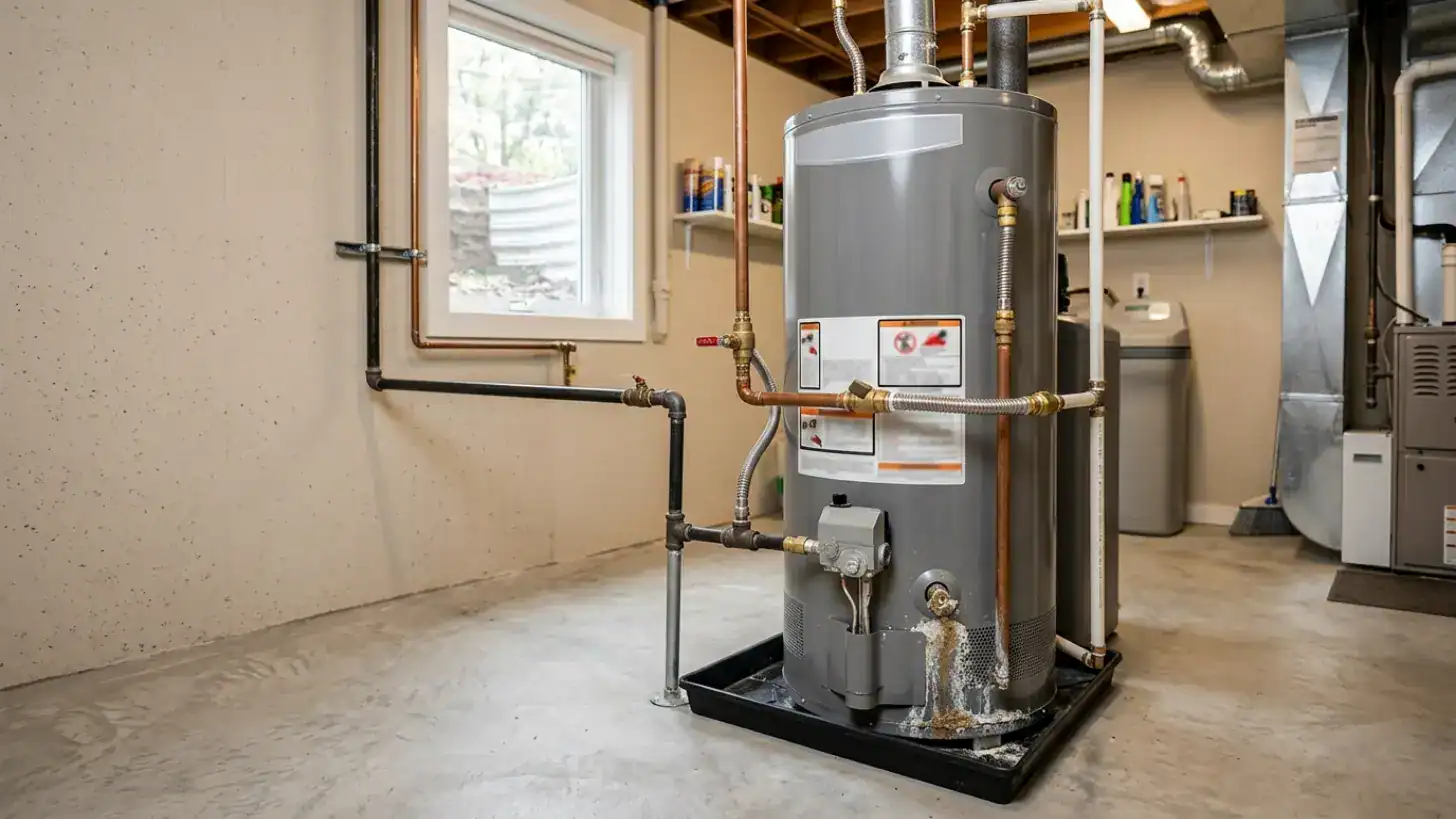
- Water pooling at the base of the tank — once the tank body itself is leaking, the unit cannot be repaired
- Inconsistent temperature or noticeably less hot water than it used to provide
- The unit is original to the home, and the home is older — check the manufacture date on the rating plate.
If you’re replacing an aging unit, it’s worth deciding between fuel types first — see our gas vs electric water heater guide for Lincoln, NE.
Don’t guess your water heater’s age. Check the rating plate on the tank — most manufacturers encode the manufacture date into the serial number. If it’s not obvious, a plumber can decode it in seconds.
What actually extends a water heater’s life
None of this means Lincoln homeowners are stuck replacing water heaters early. A few habits make a measurable difference:
4 habits that add years to your tank
- Annual tank flushing — draining a few gallons from the bottom valve clears loose sediment before it hardens into scale
- Anode rod inspection every 2–3 years — a rod that’s mostly dissolved should be replaced, not ignored
- Water softener installation — the single biggest lever for homes on Lincoln’s municipal supply, since it removes minerals before they reach the tank
- Setting the thermostat to 120°F — higher settings accelerate both scale formation and tank wear without meaningfully improving usability
If your unit needs work now, see our guide on water heater repair costs in Lincoln, NE to know what to expect before you call.
Repair or replace? A quick way to think about it
If your water heater is under 6 years old and the problem is a single component — a thermocouple, heating element, or thermostat — repair is almost always the right call. Past year 10, especially with rust at the tank seams or a second repair within two years, the math usually favors replacement, since you’re paying to extend the life of a tank that’s already working against you.
The honest answer is rarely obvious from a phone call, which is why a real inspection — checking the anode rod, the sediment level, and the tank body itself — is worth more than a guess based on age alone.
if your water heater needs more than a quick fix, our water heater repair team in Lincoln, NE can walk you through it.
Frequently asked questions
Not sure if your water heater needs a repair or a replacement? Our licensed Plumbers in Lincoln NE, will inspect the tank, check the anode rod and sediment level, and give you a straight answer, same-day, with upfront pricing.